The Raygun Gothic Rocketship featured on KRON 4- Best of the Bay
July 17th, 2010 by sorlando
Laughing Squid
June 18th, 2010 by sorlando

Black Rock Arts Foundation has just announced that the amazing Raygun Gothic Rocketship will be installed at Pier 14 in San Francisco thist August 2010 and will remain on display through September 2011.
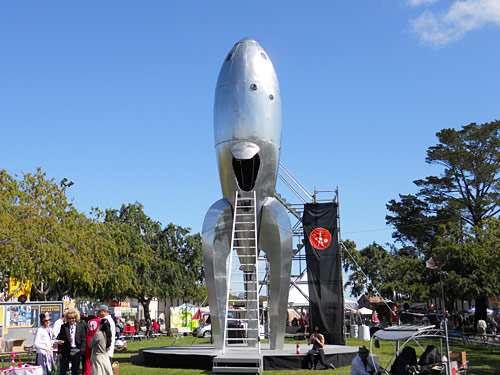
The 40-foot-tall art piece, The Raygun Gothic Rocketship, offers rococo-futuristic, highly-stylized vision of space travel circa 1930’s-1940’s science fiction and is the latest in a series of temporary public art exhibitions sponsored by BRAF with the aim of enlivening and activating public spaces. The installation first landed at Burning Man 2009, and has subsequently appeared at NASA Ames for Yuri’s Night, and at Maker Faire. The piece is comprised of a single rocketship, poised as if to board passengers for a typical run to a nearby stellar destination. When installed in San Francisco, the sculpture will be accompanied by a descriptive exhibit, a “rocket stop”, which tells the story of the rocketship, provides route, schedule and other information. The installation will be illuminated for nighttime viewing.
Although this ambitious project has won overwhelming city and public support and enthusiasm, we need your help to make it happen! Help BRAF and the Raygun Gothic Rocketship crew make science fiction an everyday reality to hundreds of thousands of residents and visitors to the San Francisco Embarcadero.
Here’s how you can donate to BRAF to help make this project a reality.
The Rocketship is Coming to San Francisco!!
June 9th, 2010 by dshulman
Late yesterday afternoon, the SF Port Commission voted unanimously to approve the installation of the Raygun Gothic Rocketship at Pier 14, on the San Francisco Waterfront. Along with the approval, the Port also agreed to donate $15,000 towards our project budget.
A small crew contingent, along with members of BRAF, and Leslie Pritchett – our steadfast liaison throughout this process, were on hand for the meeting.
Our contacts at the Port, Dan and Phil, did a great job of organizing the proposal, outlining the mechanics of the installation and addressing basic questions and concerns. Speaking in support of our project and temporary art in general was Mike Farrah, a senior adviser to Mayor Gavin Newsom, and PJ Johnston, President of the SF Arts Commission.
So with the approval in hand, the hard work can begin. Stay tuned for more exciting details on fundraising, ship prep, Rocket Stop fabrication, and much more!
SF Examiner Article “Rocket art landing on SF Waterfront”
June 7th, 2010 by dshulman
Check out today’s SF Examiner for the article about the hoped-for installation at Pier 14.
See it here: Link
Bring the Rocket Stop to San Francisco
June 6th, 2010 by dshulman
That’s right folks – at the Port Commission of San Francisco’s next meeting, on Tuesday June 8th, they will discuss and have the opportunity to approve the installation of the Raygun Gothic Rocket at Pier 14 on the SF Embarcadero!
This is a tremendous opportunity for the crew and supporters of the Rocketship, for the Black Rock Arts Foundation, and for all of those citizens that would like to see more public art in our city. Although the rocketship will be closed to visitors, we are designing an informative kiosk, very much in keeping with the overall aesthetic of the ship, that will delight and share our story with the public. Cast in the guise of a ‘rocket stop’, it is to space travel what the bus stop is to public transportation.
The installation is being sponsored by the Black Rock Arts Foundation, with financial support from the Port of San Francisco and people like you! (More information on how to help will be posted once we receive official approval.)
The (open session of the) Port meeting will be held on Tuesday June 8th, beginning at 3:15 PM. We are item #10 on the agenda. Public comment is permitted, and we’d love to see some of you come out and voice your support for this opportunity.
In the meantime, check out the beautiful fundraising poster created by our Chief Design Rocketeer Jody Medich:

Pier 14 Fundraising poster by Jody Medich
Rest assured we’ll be in touch following the meeting.
Grab your towel, and get ready for an adventure!
Pictures of the Raygun Gothic Rocketship on Popularmechanics.com
May 25th, 2010 by sorlando
The Road to Maker Faire: How to Launch a rocket!
May 21st, 2010 by sorlando
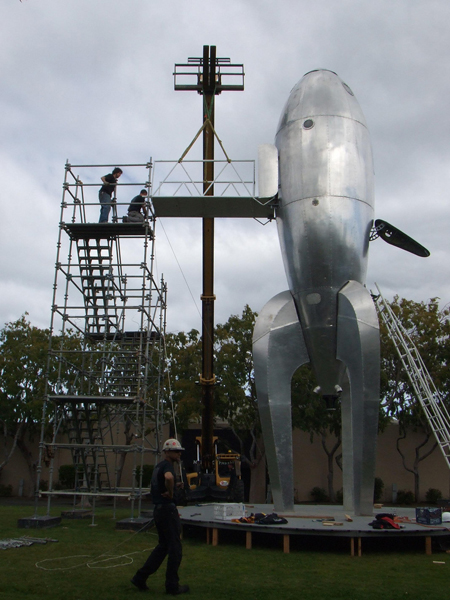
The Raygun Gothic Rocketship has been successfully installed and is “standing by,” ready for the 2010 Makers Faire weekend. Our gantry tower has been erected and the explosive bolts on the escape hatch are armed!
We are all systems go…!
The RGR is more than just a shiny outer hull… and so we wanted to give you a brief glimpse of what you’ll find inside. To begin, here’s a post by one of the lead artists on the RGR project, David Shulman, talking about our deployable on-board rocket (probe)launcher.
SeanO
How to Launch a Rocket… from a Raygun Gothic Rocketship
by David Shulman
Every rocketship needs a rocket launcher, right?! In case you want to launch a probe? Or need to fire a space torpedo? Since my friends and I were already building a rocketship, I decided that we needed to build a rocket launcher too. The fact that I’ve never built a kinetic mechanism before should not be a deterrent, right?! I thought long and hard about what qualities it should have. Something that can be activated from inside; a launch platform that deploys from the side of the ship; a clear blast shield that allows you to witness the launch, and a mirrored outer hull cover that lets you follow the ascent. My friend John Hollis and I started to scheme.
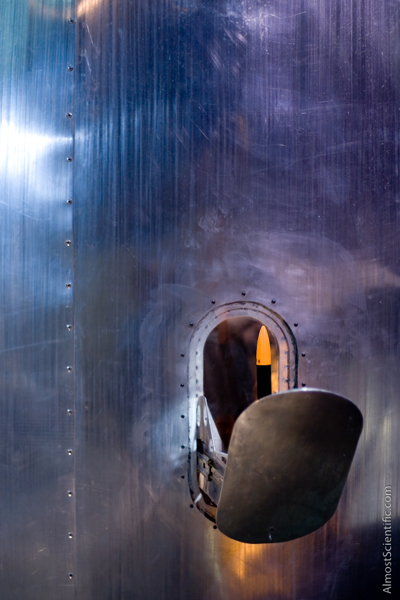
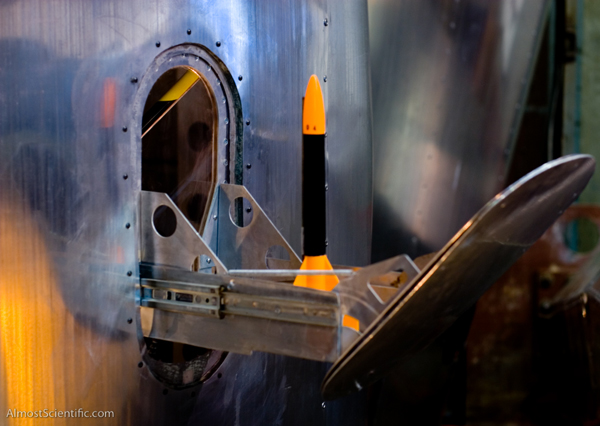
The first iteration was a temporary success; driven by a linear actuator following a curved path and operating a lever, it extended an aluminum tray out of the body of the main ship, and electrically fired an Estes rocket. I said it was a temporary success, because after five days of use, it failed (granted, it was Burningman) – the actuator ceased to function, although the firing mechanism still worked. (We could, and therefore did, continue to launch rockets for several more days.)
We got back to the shop, only to discover that the actuator was fine – a simple toggle switch had suffered an internal failure. No matter – the Mark II was destined to be better, anyway. We planned to swap the linear actuator for a rack and pinion gear, as it would reduce the space needed, which on a spaceship is always helpful.
The Mark II.a (reployed at Yuri’s Night, at NASA Ames Research Center) worked OK, but we found that the rack and pinion actually needed to be perfectly aligned and spaced to work smoothly. Who would’ve thought?! With the Mark II.b (this weekend’s Maker Faire), we added limit switches, to stop the motor when the tray hit the end of its travel, to prevent burn out.
In the shop, it all worked – we tested it thoroughly, and found no problems after a dozen cycles. Imagine my consternation when, trying to test-launch a probe to measure wind direction on the midway yesterday. — it didn’t work! I toggled “extend” and it would not go. But when I tried “retract,” I had no problem?
I could not figure it out. Everything checked out, there were no shorts, (other than the ones I inadvertently caused ), all the switches were working, but I could not find the problem.
Finally, I thought to check the default on the limit switches. Sure enough, the outer limit switch was wired backwards! I have no idea how we tested successfully in the shop – but at 5:30 PM on Wednesday of set-up week – I had it! It went something like this:
- Estes Alpha II, with an A6-3 engine, racked and ready for launch.
- Deploy the launch assembly.
- Arm the ignition system.
- Ask a passerby to tell me (from outside the ship) which direction my probe goes.
- 3, 2, 1…
- Launch!
And the results?
The good news: a successful test launch!
The bad news.: an offering to the rocket gods.
(If you find the lost rocket, or any other we might launch over the weekend, bring it back to us, and come straight to the head of the line! Or, if you can explain what allowed us to test successfully in the shop, then find a problem in the field, you get to launch one!)