Archive for the ‘News’ Category
Robots and Rockets: Mashable highlights at Maker Faire
Monday, May 24th, 2010The Road to Maker Faire: How to Launch a rocket!
Friday, May 21st, 2010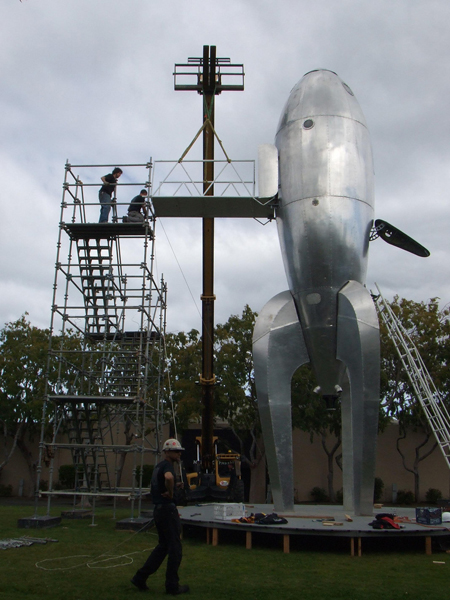
The Raygun Gothic Rocketship has been successfully installed and is “standing by,” ready for the 2010 Makers Faire weekend. Our gantry tower has been erected and the explosive bolts on the escape hatch are armed!
We are all systems go…!
The RGR is more than just a shiny outer hull… and so we wanted to give you a brief glimpse of what you’ll find inside. To begin, here’s a post by one of the lead artists on the RGR project, David Shulman, talking about our deployable on-board rocket (probe)launcher.
SeanO
How to Launch a Rocket… from a Raygun Gothic Rocketship
by David Shulman
Every rocketship needs a rocket launcher, right?! In case you want to launch a probe? Or need to fire a space torpedo? Since my friends and I were already building a rocketship, I decided that we needed to build a rocket launcher too. The fact that I’ve never built a kinetic mechanism before should not be a deterrent, right?! I thought long and hard about what qualities it should have. Something that can be activated from inside; a launch platform that deploys from the side of the ship; a clear blast shield that allows you to witness the launch, and a mirrored outer hull cover that lets you follow the ascent. My friend John Hollis and I started to scheme.
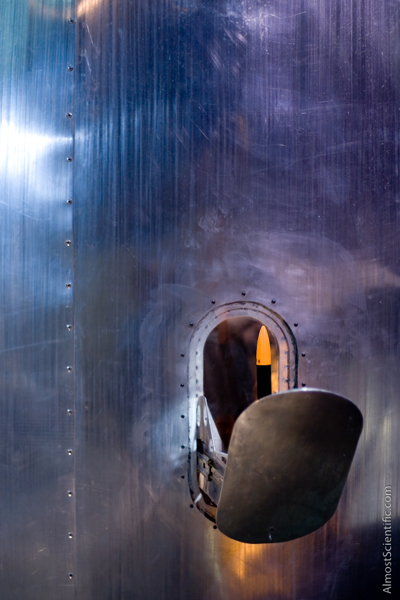
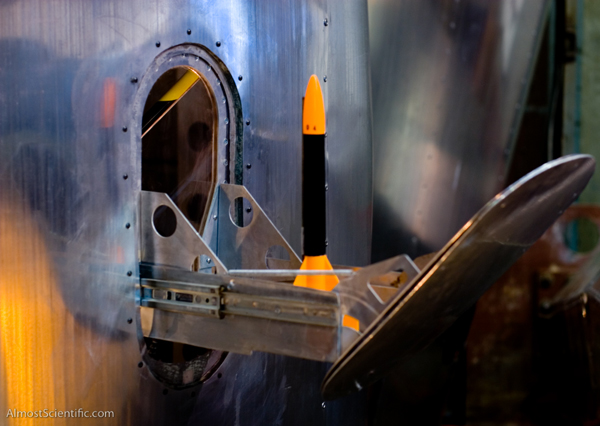
The first iteration was a temporary success; driven by a linear actuator following a curved path and operating a lever, it extended an aluminum tray out of the body of the main ship, and electrically fired an Estes rocket. I said it was a temporary success, because after five days of use, it failed (granted, it was Burningman) – the actuator ceased to function, although the firing mechanism still worked. (We could, and therefore did, continue to launch rockets for several more days.)
We got back to the shop, only to discover that the actuator was fine – a simple toggle switch had suffered an internal failure. No matter – the Mark II was destined to be better, anyway. We planned to swap the linear actuator for a rack and pinion gear, as it would reduce the space needed, which on a spaceship is always helpful.
The Mark II.a (reployed at Yuri’s Night, at NASA Ames Research Center) worked OK, but we found that the rack and pinion actually needed to be perfectly aligned and spaced to work smoothly. Who would’ve thought?! With the Mark II.b (this weekend’s Maker Faire), we added limit switches, to stop the motor when the tray hit the end of its travel, to prevent burn out.
In the shop, it all worked – we tested it thoroughly, and found no problems after a dozen cycles. Imagine my consternation when, trying to test-launch a probe to measure wind direction on the midway yesterday. — it didn’t work! I toggled “extend” and it would not go. But when I tried “retract,” I had no problem?
I could not figure it out. Everything checked out, there were no shorts, (other than the ones I inadvertently caused ), all the switches were working, but I could not find the problem.
Finally, I thought to check the default on the limit switches. Sure enough, the outer limit switch was wired backwards! I have no idea how we tested successfully in the shop – but at 5:30 PM on Wednesday of set-up week – I had it! It went something like this:
- Estes Alpha II, with an A6-3 engine, racked and ready for launch.
- Deploy the launch assembly.
- Arm the ignition system.
- Ask a passerby to tell me (from outside the ship) which direction my probe goes.
- 3, 2, 1…
- Launch!
And the results?
The good news: a successful test launch!
The bad news.: an offering to the rocket gods.
(If you find the lost rocket, or any other we might launch over the weekend, bring it back to us, and come straight to the head of the line! Or, if you can explain what allowed us to test successfully in the shop, then find a problem in the field, you get to launch one!)
The Road to Maker Faire: Greetings Earthlings!
Tuesday, May 18th, 2010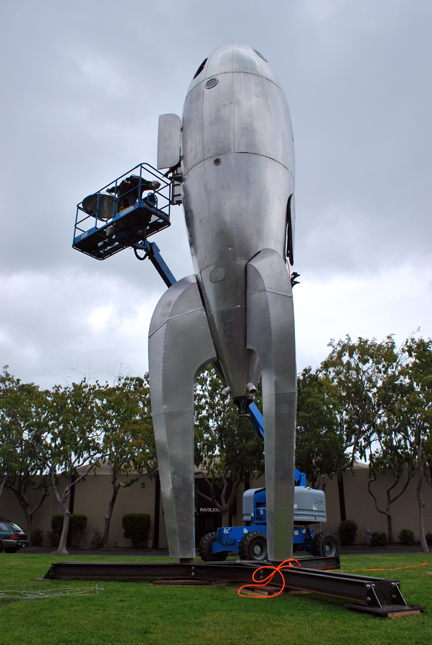
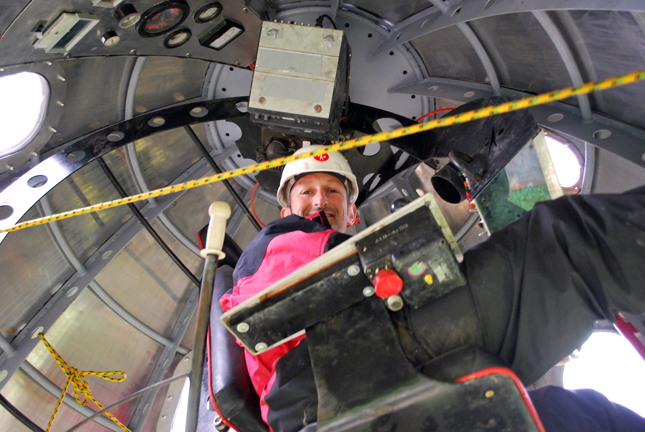
The Raygun Gothic Rocketship and her crew arrived in San Mateo, Earth today, on the 17th day of the 5th month in the year 2010. After an uneventful 12-hour trans-galactic journey across the western reaches of the Sobay Nebula, our sturdy and resilient little ship finally settled down on the grassy planetary landscape that will soon be densely populated by the rare and interesting Humanus Makeriferous Species. We look forward to studying their kind…
The RGR Crew will be docked for approximately seven Earth days in order to take on supplies, refresh our reading material, and to grant shore leave to the crew. Ship tours will commence on the day of the Saturn and will continue until the moon rises on the day of the Sun.
To all you Space Cadets out there! The RGR Crew is recruiting! Stop by our space port and pick up a Raygun Gothic Rocketeer recruitment packet today!
Follow the exploits of the RGR Crew on the The road to Maker Faire on Make: Online
RGR Lead Artists interviewed for the Make Blog
Thursday, April 29th, 2010MFBA: Interview with Raygun Gothic Rocketship crew

Maker Faire Bay Area, the world’s largest DIY festival, is right around the corner, taking place at the San Mateo Fairgrounds on May 22nd and 23rd. One of the biggest new projects coming to the Faire this year is the Raygun Gothic Rocketship, pictured above and hand-crafted by a large and dedicated crew. We sent seven questions to the crew’s three lead artists, Sean Orlando, Nathaniel Taylor, and David Shulman. Here’s what they had to say.
1. Tell us about the project you’re bringing to Maker Faire.
The Raygun Gothic Rocketship is built upon a future-rustic vision of yesterday’s tomorrow. Aesthetically based on 1930s – early 1950s science fiction, the rocketship is a 41-foot-tall immersive environment, designed to carry explorers into the realm of rayguns, strange planets, and aliens, friendly or otherwise.

With 3 habitable decks, visitors can view and interact with a variety of ships systems and alien specimens. Visitors can enter the ship via the Engine Room & Life-Sciences Bio Lab. Once inside the engine room, look down into the engine compartment to see The Uira Plasma-drive engine. Cases and cages on the walls contain various creatures we’ve collected in our travels. Check on the ships status with the Systems Monitor, or speak to the Pilot via the tele-com.

Moving up a deck, you’ll find Crew Quarters, Navigation, Communications & Remote Sensing. Check our approach trajectories using the Neutronium Scanner, confirm our location using one of several navigational devices, or deploy a remote probe via the Hollis 9000 Remote Science System. Finally, you can climb up to the flight deck and pilots chair. Take command of the ship and prepare for launch!
2. How did you hear about Maker Faire and why did you decide to participate?
As a group, we have been fans of or involved with the Maker movement and Maker Faire for many years. Many of our crew have shown other works, both large and small, at past MAKE events in association with such groups as The Crucible, Applied Kinetic Arts, Kinetic Steam Works, and SRL.
3. Tell us about yourself. How did you get started making things and who are your inspirations?
The three of us all have different stories.

David Shulman: I began making things with my father as a kid — mostly simple furniture. He inspired me in that he was an attorney, yet was not afraid to get his hands dirty, or try new things, and I have followed a similar path.

Sean Orlando: I’ve been tinkering and inventing for as long as I can remember. Creating three-dimensional artworks resonated with me more than any of the other art practice that I experimented with. My father was an aerospace engineer and exposed me to airplane and rocket engineering at an early age. The engineering challenges, collaborative creative process, and immersive potential of large-scale installations allowed me to explore a whole new level of art making… with friends.

Nathaniel Taylor: Nathaniel was born with a tool in his hands. He is the Chief Operating Officer and creative mind behind Radio Robot.
4. Is your project strictly a hobby or a budding business? Does it relate to your day job?
Our project is both. Through the RGR and past projects (such as the Steampunk Tree House), we are exploring the concept of cooperative art as both a focus for creative community, and an opportunity to generate income for our member artists. The Five Ton Crane Arts Group was formed as a direct result of these successful collaborations.
5. What new idea (in or outside of your field) has excited you most recently?
We are constantly inspired and motivated by artistic invention, clever engineering solutions, and creative collaboration. We strive to create immersive environments that combine sculpture, kinetics, performance, interactivity, and creative collaboration. It’s exciting to see the latest inventions coming out of Europe by such groups as Royal de Luxe and La Machine.
6. What is your motto?
“Art is better with friends.”
“We aim to be rather than to seem.”
“Just because it hasn’t been done before, doesn’t mean it can’t be done.”
7. What advice would you give to the young makers out there just getting started?
Just do it. Don’t hesitate for fear of challenge or failure. Don’t get caught up in what “seems” to be impossible. Just because it hasn’t been done before, doesn’t mean it can’t be done. The benefits of your realized ideas are not only experienced in the end result of your experiments. There is so much fun to also be had through the process of invention, creative problem solving, overcoming challenges, and working together as a team.
Thanks, gentlemen, words of widsom for sure! We’re excited to see the Rocketship in its full glory at Maker Faire. You can still get discounted tickets until May 12. For all the information you need, head over to the Maker Faire website.
RGR featured on the cover of the Mountain View Post
Friday, April 16th, 2010Moffett a space-age playground for ‘Yuri’s Night’
Stunt planes, hip-hop, crazy art and more mark NASA celebration in honor of Russian cosmonaut
Click here for the full article
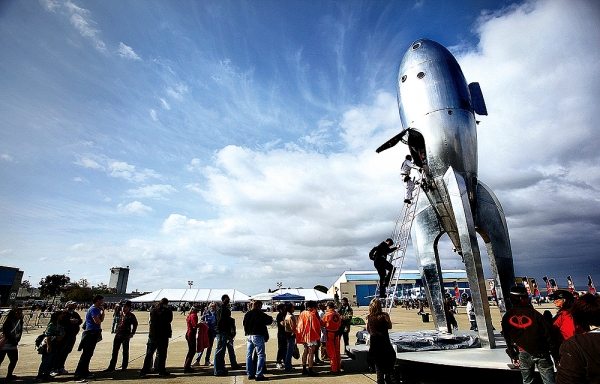
NBC Bay Area: The Raygun Gothic Rocketship at NASA Ames for Yuri’s Night
Tuesday, April 13th, 2010The Rocketship was a huge hit at this weekend’s Yuri’s Night Festival at the NASA Ames Research Center ion Mountain View California.
First press is coming in now…check it out!
The Raygun Gothic Rocketship featured on the NASA Ames website
Friday, March 26th, 2010Click HERE for the full story
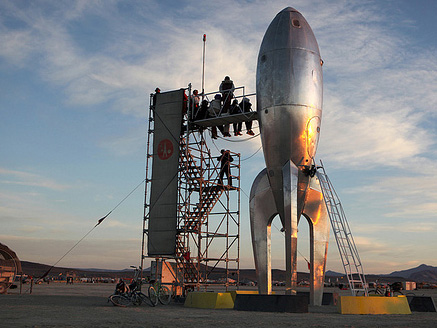
photo by Sean Donnelly
A 40-foot high rocket from the future and a 20-foot tall bird with its head and wings on fire will light up on Saturday, April 10, 2010 at NASA Ames Research Center, Moffett Field, Calif. Is this a science experiment gone awry? No, it’s all part of Yuri’s Night.
Yuri’s Night is a world space party that commemorates the anniversary of the first human spaceflight, by Russian cosmonaut Yuri Gagarin on April 12, 1961 and the first space shuttle mission 20 years later. An estimated 10,000 people are expected to attend the Bay Area celebration from noon to midnight.
During this “mash-up” of music, dance, technology, art and space, two large-scale art installations that previously have been exhibited at the Burning Man Festival will be displayed: the “Raygun Gothic Rocketship” and “Angel of the Apocalypse.”
What these two giant sculptures share in common is that they both were built by dozens of team members collectively working together.
Sean Orlando, one of three lead artists for “Raygun Gothic Rocketship,” said the effort required the work of 85 artists, engineers, fabricators, scientists and computer engineers. “One of the remarkable things about this group of people is how few issues there are,” said Orlando. “When it comes to actual work and the design process, it truly is very collaborative.”
The retro-futuristic rocket stands four stories high, weighs 3,500 pounds and requires a crane with a 40-foot, 5-ton installation capability. The structure is divided into three sections: a life sciences bio lab, engineering room, crew quarters and a command module. Interior details include “alien specimens” in the life sciences bio lab, a zero gravity bed and a deployable rocket launcher.
“We’re sci-fi geeks who like to play with machines and tools,” said lead artist David Shulman. “Our inspiration was from the 1930s through early 1950s when technology was within sight, but the reality of what it would entail or the Cold War pessimism had not set in yet.”
The term, “Raygun Gothic” is an artistic style coined by science fiction author William Gibson. Orlando said the name refers to how people in the past imagined the future.
“We’re thrilled to be able to bring it to a NASA facility and share it with people who are interested in space exploration—both the serious side and the fun side,” said Orlando.
Click HERE for the full story
Limited Edition Raygun Gothic Rocketship Papercraft Models For Sale
Wednesday, March 10th, 2010Limited edition papercraft models of The Raygun Gothic Rocketship are for sale on Makers Market.
We’re not going to say exactly how we got these…
But we will say there are several Tublians on Neblous-9 who risked allot to get these to us. I hope none of them lost any gills getting them to us.
Here are Top Secret Rocket Corps documents (Dogstar clearance and higher!) that have full specifications and Materliser specs for The Raygun Gothic Rocketship.
Normally these could produce a perfect, working, Raygun Gothic Rocketship by printing on Piperiarian Dimensional Flux Sheet, assembling it with nanobots and placing it in a 7-axis Materliser.
However, because such technology is banned on Earth (don’t complain to us, send a beammail to your Universe Senator), we’ve printed them on on 100lb glossy paper.
You can use a sharp knife and some adhesive to make yourself a scale, paper model of The Raygun Gothic Rocketship.
For $12.50 you get a full papercraft model printed on 100lb. glossy paper that we mail to you.
Join the Rocket Corps today!
Created by Almost Scientific
Wooden prototype model of the Raygun Gothic Rocketship
Wednesday, March 10th, 2010Created by Almost Scientific
New York Times: Space & Cosmos
Monday, March 8th, 2010
Reaching for the Stars When Space Was a Thrill

Using aviation industry ads, a new book revisits a time when outer space still thrilled, and cold war paranoia reigned.

By DENNIS OVERBYE
Published: March 8, 2010
It was “Mad Men” meets “Flash Gordon.”
The years from 1957 to 1962 were a golden age of science fiction, as well as paranoia and exhilaration on a cosmic scale. The future was still the future back then, some of us could dream of farms on the moon and heroically finned rockets blasting off from alien landscapes. Others worried about Russian moon bases.
Scientists debated whether robots or humans should explore space. Satellites and transistors were jazzy emblems of postwar technology, and we were about to unravel the secrets of the universe and tame the atom (if it did not kill us first).
Some of the most extravagant of these visions of the future came not from cheap paperbacks, but from corporations buffing their high-tech credentials and recruiting engineering talent in the heady days when zooming budgets for defense and NASA had created a gold rush in outer space.
In the pages of magazines like Aviation Week, Missiles and Rockets and even Fortune, companies, some famous and some now obscure, were engaged in a sort of leapfrog of dreams. And so, for example, Republic Aviation of Farmingdale, N.Y. — “Designers and Builders of the Incomparable Thundercraft” — could be found bragging in Aviation Week and Space Technology magazine in 1959 about the lunar gardening experiments it was doing for a future Air Force base on the moon.
Or the American Bosch Arma Corporation showing off, in Fortune, its “Cosmic Butterfly,” a solar-powered electrically propelled vehicle to ferry passengers and cargo across the solar system.
Most Americans never saw these concoctions, but now they have been collected and dissected by Megan Prelinger, an independent historian and space buff, in a new book, “Another Science Fiction: Advertising the Space Race 1957-1962.” It is being published on May 25 by Blast Books.
Ms. Prelinger and her husband, Rick, operate the Prelinger Library, a private research library in San Francisco with a heavy emphasis on media, technology and landscape history.
In an e-mail message, Ms. Prelinger said she had grown up “on a cultural diet of science fiction and space,” memories of the moon landings and “Star Trek” merging in her mind. “As a result,” she said, “I grew up believing that I was a junior member of an advanced technological society.”
The book, she said, was inspired by a shipment of old publications to the library, including Aviation Week & Space Technology and Missiles and Rockets. “I little expected that the advertising in their pages would seize my attention more than the articles themselves,” she writes in the introduction to her book.
The ads are chock-full of modernist energy and rich in iconography in ways Ms. Prelinger is happy to elaborate on.
The late ’50s were also the years of the Organization Man. The cover illustration, from an insurance ad, shows a man in a gray flannel suit who is a dead ringer for the existentially confused Don Draper of “Mad Men,” floating alarmed and bewildered among the planets and stars. Time and again, the mountains and valleys of the moon, for example, are portrayed as if they were the mountains, canyons and deserts of the American West, making the space program just another chapter in the ongoing narrative of Manifest Destiny.
In one illustration, the hands of God and Adam from Michelangelo’s Sistine Chapel ceiling have been transformed into a giant pair of space gloves reaching for each other. In another, the silhouette of a spaceship forms a cross.
“These images suggest that the furthest reach of what humankind hoped to find in space was in fact the very essence of infinity,” Ms. Prelinger writes.
Leafing through this book is a walk down my own memory lane. I grew up in Seattle, which was a one-company town dominated by Boeing. Almost everybody worked there sooner or later. My best friend’s father helped design the Saturn V rocket that lifted humans to the moon. After limping out of M.I.T. with a physics degree in the late ’60s, I, too, worked there for a year, playing a kind of space war — shooting high-speed aluminum balls at sheets of aluminum arrayed to simulate the structures of aircraft or spacecraft, to see what the damage would be under various conditions. At the end of the day, my desk was buried in piles of sharp dented and charred sheets of aluminum. I had to count all the holes.
It’s hard to know what to be more nostalgic about, all those childhood dreams of space opera or the optimism of an era in which imagination and technology were booming and every other ad ended with a pitch to come work for the thriving company of the future. “To advance yourself professionally, you should become a member of one these teams. Write to N. M. Pagan,” reads a typical notice from the Martin Company, now part of Lockheed Martin.
You don’t hear that much these days.
Back then, you, too, sitting at a drafting table or in a cubicle, designing antennas or self-locking nuts among acres of such boards and cubicles — “Reaching for the Moon, Mr. Designer?” reads a Kaylock ad — could be a space hero.
And of course it was almost exclusively men depicted in the ads. One exception was an ad from the National Cash Register Company for a new electronic machine for posting checks. “And what the POST-TRONIC does electronically the operator cannot do wrong — because she doesn’t do it at all!” says the ad showing a woman floating in space at the machine’s console.
Naturally, there was a hook to those recruitment ads, as Ms. Prelinger points out. The real business of most of those aerospace companies was not the space program but defense — building fighters, bombers, missiles and other implements of the cold war, not to mention commercial airliners. For many of these places, the space program was more of a hindrance than a boost to the bottom line, a sort of prestigious loss leader to attract cutting-edge talent.
Occasionally, as Ms. Prelinger reports, the darker side of this work bled through into the trade press and the ads, like when the Marquardt Corporation, which made small control rockets for satellites, showed a spy satellite aiming its lens down at Earth.
If the space fever began in 1957 with Sputnik, it cooled by 1962, when the basic plan for the Apollo moon missions was set and there was no more space for imaginations to run wild. Also, by then NASA’s budget was leveling off. Ms. Prelinger said that during this period about half a million engineers, scientists, draftsmen and other people followed the clarion call to blend their talents into the new age, swelling the ranks of aerospace workers to more than a million.
Some of them might have wound up like me. When the “impact mechanics” group was downsized, I was sent to the “weights and measures” group. Our job was to scrutinize rocket blueprints to determine the position and weight of every nut, bolt, washer and any other item on a small upper-stage booster that was to deliver an unknown payload to orbit. The information could be entered into a computer program that would calculate the center of gravity and other dynamical properties of the rocket package.
It was essential but brain-numbing work, and I learned a lot about shooting rubber bands from the wars that broke out every day after lunch.
But it was men and women like these, working in cubicles, who saved the astronauts of Apollo 13 in 1969, by figuring out how to bring them back from the moon alive in a crippled spacecraft.
In the wake of the moon landings and then the end of the cold war, many of those jobs, exciting or not, disappeared, as did many of the companies that advertised them. What has not disappeared in all these years and decades is the yearning and arguing about space.
We’re still fighting about what NASA should do as far as human exploration of the universe is concerned, collectively looking more and more like that bewildered advertising man floating in space on the cover of Ms. Prelinger’s fascinating book. The argument has been going on for my whole life. Since those advertisements appeared, the United States invaded Vietnam and left; the Soviet Union crumbled and China rose; the whole nation stopped smoking.
We never did find the essence of infinity — at least not yet.